Shapley Additive Global Importance (SAGE)
Source:vignettes/articles/sage-methods.Rmd
sage-methods.RmdIntroduction
Shapley Additive Global Importance (SAGE) is a feature importance method based on cooperative game theory. It uses Shapley values to distribute the model’s total prediction performance among features. Unlike perturbation-based methods (PFI/CFI) that measure performance degradation when features are perturbed, SAGE measures each feature’s contribution through marginalization.
A key property of SAGE is that it provides a complete decomposition: the sum of all SAGE values equals the difference between the model’s performance and the performance when all features are marginalized.
xplainfi provides two implementations:
- MarginalSAGE: Marginalizes features independently (standard SAGE implementation)
- ConditionalSAGE: Marginalizes features using conditional sampling
Note on interpretation: SAGE’s theoretical properties and interpretation differ from perturbation-based methods. While PFI/CFI have clearer interpretations in terms of predictive performance, SAGE’s results can be more challenging to interpret, particularly when using conditional sampling. The choice of conditional sampler can significantly affect results, and there is limited empirical guidance on best practices. This vignette focuses on demonstrating the methods rather than making strong interpretive claims.
The SAGE estimator implemented here is what is
referred to as the “permutation estimator” in other implementations. It
works by first building up n_permutations permutations of
the feature vector and then successively evaluating prefixes of the
sequence from left to right as coalitions to evaluated. If a task has
features (x1, x2, x3), one permutation could be
(x2, x1, x3), resulting in these coalitions to be
evaluated: (x2), (x2, x1), and
(x2, x1, x3). The empty coalition will always be evaluated,
resulting in a total number of evaluations of
n_permutations * n_features + 1.
Demonstration with Correlated Features
To showcase the difference between Marginal and Conditional SAGE,
we’ll use the sim_dgp_correlated() function which creates a
simple linear DGP with two correlated features.
Model: \[(X_1, X_2)^T \sim \text{MVN}(0, \Sigma)\]
where \(\Sigma\) is a 2×2 covariance matrix with 1 on the diagonal and correlation \(r\) (default 0.5) on the off-diagonal.
\[X_3 \sim N(0,1), \quad X_4 \sim N(0,1)\] \[Y = 2 \cdot X_1 + X_3 + \varepsilon\]
where \(\varepsilon \sim N(0, 0.2^2)\).
Data generating process:
-
x1has a direct effect on y (β=2.0) -
x2is correlated with x1 (r = 0.5) but has no direct effect on y -
x3is independent with a direct effect (β=1.0) -
x4is independent noise (β=0)
set.seed(123)
task = sim_dgp_correlated(n = 1000, r = 0.5)

# Check the correlation structure
task_data = task$data()
correlation_matrix = cor(task_data[, c("x1", "x2", "x3", "x4")])
round(correlation_matrix, 3)
#>        x1     x2     x3     x4
#> x1  1.000  0.447 -0.005 -0.048
#> x2  0.447  1.000 -0.049 -0.054
#> x3 -0.005 -0.049  1.000  0.051
#> x4 -0.048 -0.054  0.051  1.000
This DGP allows us to observe how the two SAGE variants handle correlated features with different roles in the data generating process.
Let’s set up our learner and measure. We’ll use a random forest and instantiate a resampling to ensure both methods see the same data:
Marginal SAGE
Marginal SAGE marginalizes features independently by averaging
predictions over a subset of n_samples observations drawn
from the test dataset. We use 15 permutations of the feature vector to
build coalitions, resulting in 61 evaluated coalitions
(15 * 4 + 1).
# Create Marginal SAGE instance
marginal_sage = MarginalSAGE$new(
    task = task,
    learner = learner,
    measure = measure,
    resampling = resampling,
    n_permutations = 15L,
    n_samples = 100L
)

# Compute SAGE values
marginal_sage$compute(batch_size = 5000L)
#> ℹ The permutation estimator will evaluate 61 coalitions, at least as many as
#>   enumerating all 16 (2^4) coalitions.
#> ℹ `estimator = "exact"` computes SAGE values without coalition-sampling error
#>   at the same or lower cost (for <ConditionalSAGE>, oversampling can still be
#>   deliberate; see the `estimator` docs).
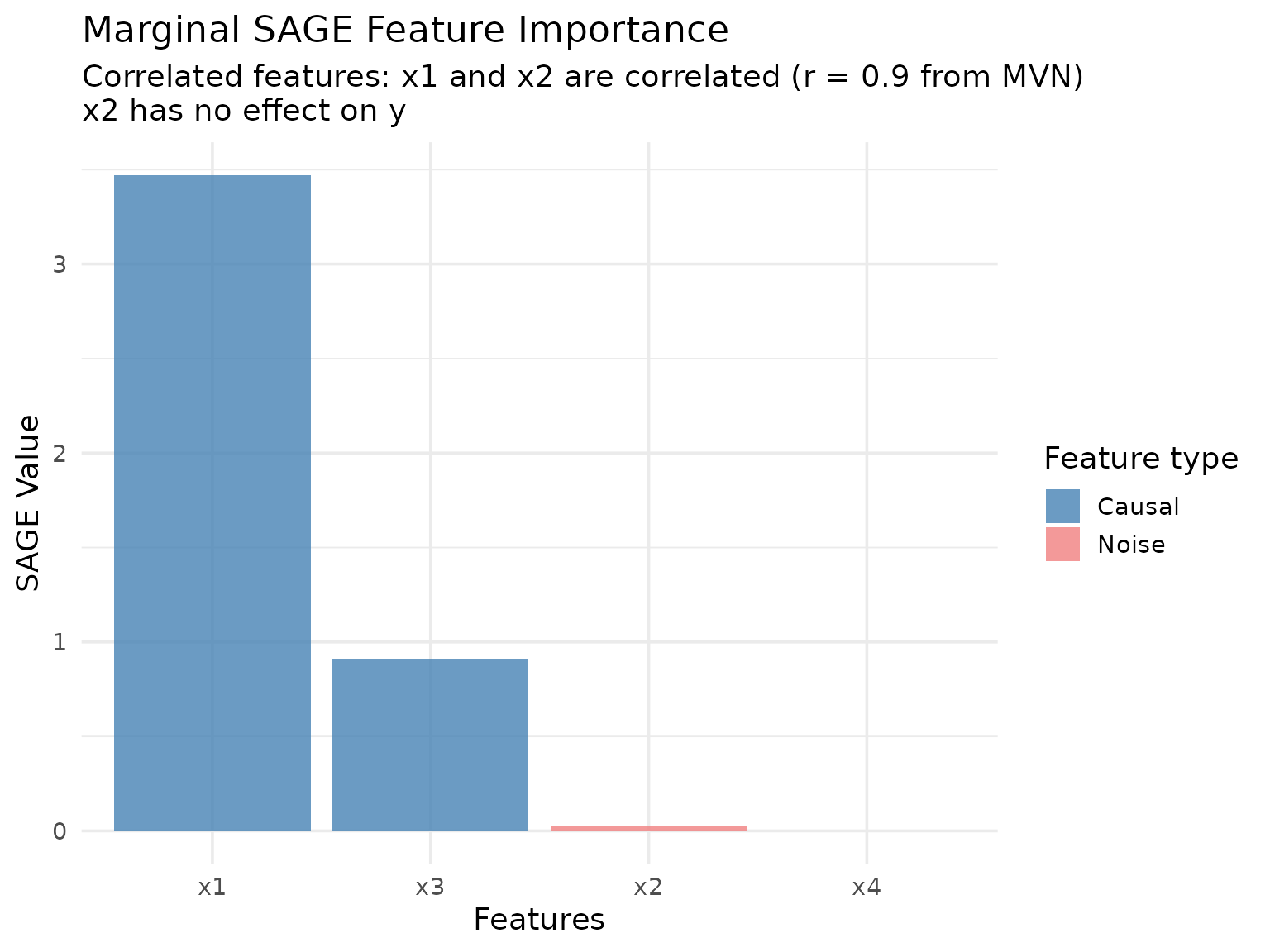
Let’s visualize the results:
We can also keep track of the SAGE value approximation across permutations:
marginal_sage$plot_convergence()
#> Warning: Removed 4 rows containing missing values or values outside the scale range
#> (`geom_ribbon()`).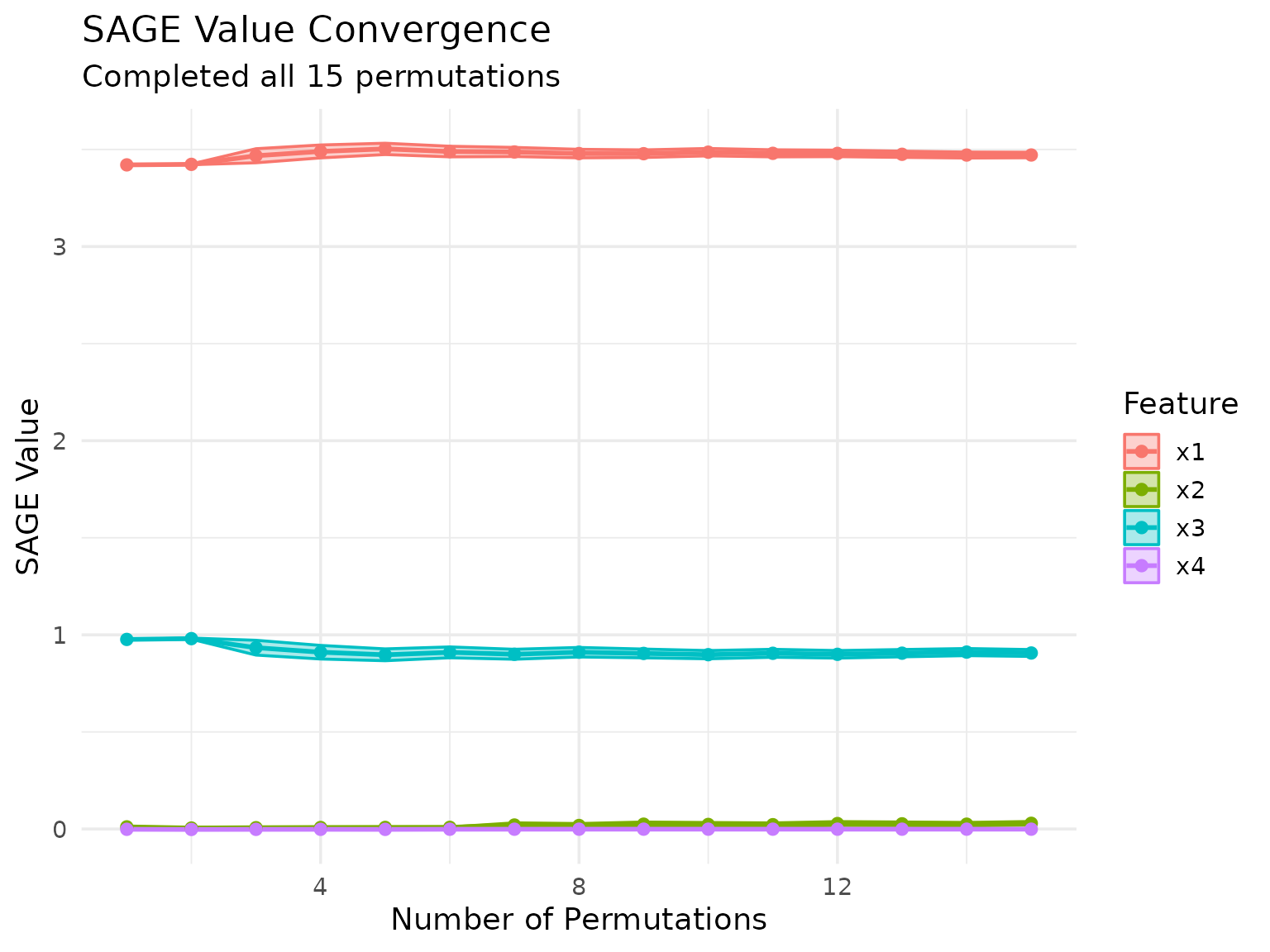
Early Stopping Based on Convergence
SAGE supports early stopping to save computation time when the
importance values have converged. It is off by default; enable it with
early_stopping = TRUE. Convergence is detected by
monitoring the standard error (SE) of the SAGE value estimates in the
first resampling iteration.
SAGE normalizes the SE by the range of their values (max - min) to make convergence detection scale-invariant across different loss metrics. Convergence is detected when:
\[ \max_j \left(\frac{SE_j}{\max_i(\text{SAGE}_i) - \min_i(\text{SAGE}_i)}\right) < \text{threshold} \]
The default threshold is se_threshold = 0.025 (2.5%),
meaning convergence occurs when the relative SE is below 2.5% of the
importance range for all features, which is the criterion and default of
the Python sage package.
With early stopping, n_permutations is an upper bound
rather than a planned cost: if the criterion is not met within it, the
values are returned with a warning.
You can customize convergence detection in
$compute():
# More strict convergence (requires more permutations)
sage$compute(early_stopping = TRUE, se_threshold = 0.005, min_permutations = 5L)

# Disable early stopping to always run all permutations
sage$compute(early_stopping = FALSE)
After computation, $budget reports the requested and
actually used effort, the implied number of evaluated coalitions, and
whether the criterion was met:
marginal_sage$budgetIf a resampling with multiple iterations (i.e., not holdout) is supplied, the budget used by the first iteration is reused for all subsequent iterations to avoid some computational overhead.
Kernel SAGE
estimator = "kernel" is the regression-based estimator
of Covert & Lee (2021), the KernelEstimator of the
Python sage package: Shapley values are the solution of a
weighted least squares problem with the Shapley kernel as weights,
approximated from sampled coalitions. Unlike the permutation estimator,
which evaluates every coalition on the whole test set, each coalition
draw here is evaluated on a single, randomly drawn test observation and
enters via the measure’s observation-wise loss. A coalition evaluation
therefore costs n_samples model rows instead of
n_test * n_samples, and the budget
n_coalitions (paired draws, each evaluating a coalition and
its complement) is correspondingly large. This requires a measure with
an observation-wise loss ("obs_loss" in
measure$properties, e.g. regr.mse or
classif.logloss, but not classif.auc), and it
is currently available for MarginalSAGE only.
kernel_sage = MarginalSAGE$new(
    task = task,
    learner = learner,
    measure = measure,
    resampling = resampling,
    estimator = "kernel",
    n_coalitions = 4096L,
    n_samples = 50L
)
kernel_sage$compute()
kernel_sage$importance()
#> Key: <feature>
#>    feature  importance
#>     <char>       <num>
#> 1:      x1  3.70660937
#> 2:      x2  0.01462180
#> 3:      x3  0.95851217
#> 4:      x4 -0.03940827
kernel_sage$budget
#>    estimator            unit requested  used n_evals n_rows converged
#>       <char>          <char>     <num> <num>   <num>  <num>    <lgcl>
#> 1:    kernel coalition draws      4096  4096    8194 442900     FALSE
kernel_sage$plot_convergence()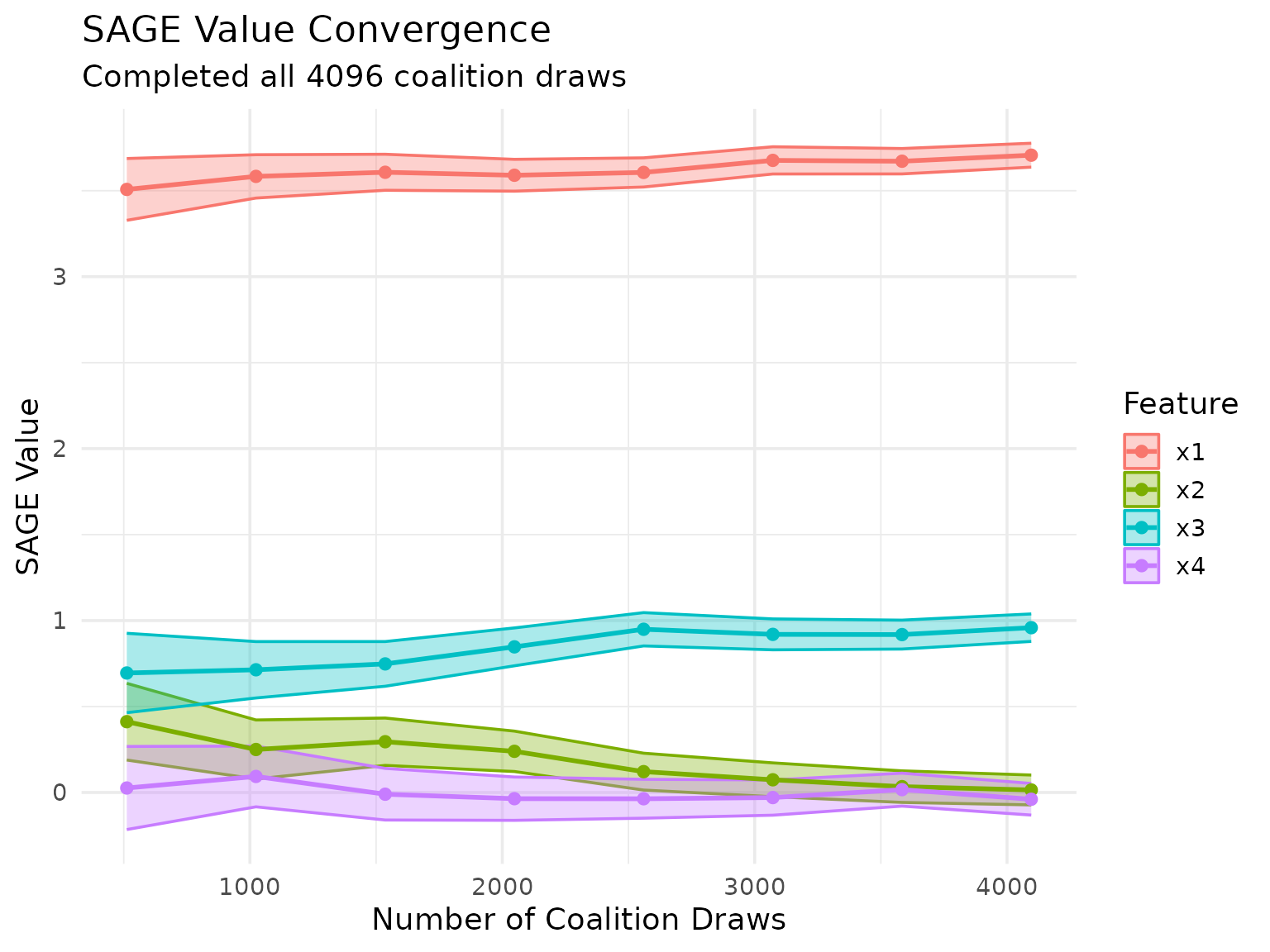
For such measures the kernel estimator targets the same SAGE values
as the permutation estimator, so the two can be compared on
$budget$n_rows, the number of model rows predicted.
Convergence is not inference
Both sampling estimators report a standard error per feature in
$convergence_history, summarized for the final estimate by
$convergence():
kernel_sage$convergence()
#>    feature  importance         se      ratio
#>     <char>       <num>      <num>      <num>
#> 1:      x1  3.70660937 0.06954240 0.02456035
#> 2:      x2  0.01462180 0.08695250 0.02456035
#> 3:      x3  0.95851217 0.07996639 0.02456035
#> 4:      x4 -0.03940827 0.09200349 0.02456035
These are Monte Carlo standard errors of the estimator for
the fixed trained model, test set, and reference subsample: they say how
much the values would still move with more sampling, which is what
early_stopping compares against se_threshold
(Covert & Lee, 2021, Section 4.3). They do not quantify uncertainty
about feature importance, since a fixed model’s SAGE values are fixed
numbers, and any nonzero value ends up several standard errors from zero
once enough coalitions are sampled. Inference about feature importance,
e.g. across train/test splits, is the job of the ci_methods
of $importance(); see the inference article.
Exact SAGE for verification
When the number of features is small, you can sidestep coalition
sampling entirely and compute the SAGE values exactly with
estimator = "exact", which enumerates all 2^p
coalitions:
task_small = sim_dgp_correlated(n = 500) # four features
resampling_s = rsmp("holdout")
resampling_s$instantiate(task_small)

sage_exact = MarginalSAGE$new(
    task = task_small,
    learner = lrn("regr.ranger", num.trees = 50),
    measure = msr("regr.mse"),
    resampling = resampling_s,
    estimator = "exact",
    n_samples = 50L
)
sage_exact$compute()
sage_exact$importance()
#> Key: <feature>
#>    feature   importance
#>     <char>        <num>
#> 1:      x1  2.636791061
#> 2:      x2  0.863743216
#> 3:      x3  0.997765064
#> 4:      x4 -0.002473804
sage_exact$budget
#>    estimator       unit requested  used n_evals n_rows converged
#>       <char>     <char>     <num> <num>   <num>  <num>    <lgcl>
#> 1:     exact coalitions        16    16      16 133600        NA
This is guarded by max_features (default 12), since the
number of coalitions grows as 2^p. It carries no
coalition-sampling error, so for MarginalSAGE it yields the
exact Shapley values of the value function that the permutation
estimator approximates, which makes it a convenient ground-truth
reference when validating or comparing estimators. The costs are
directly comparable via the number of evaluated coalitions
($budget$n_evals): 1 + n_permutations * p for
the permutation estimator and 2^p for exact enumeration.
When a permutation budget meets or exceeds the exact cost,
$compute() points this out in a message (silenced by
xplain_opt(verbose = FALSE)). Note that “exact” refers to
coalition sampling only: the marginalization error controlled
by n_samples remains, and for ConditionalSAGE
the value function is itself estimated by a sampler, so “exact” removes
the coalition-sampling error but not the sampler’s Monte Carlo
error.
Conditional SAGE
Conditional SAGE uses conditional sampling (via ARF by default) to marginalize features while preserving dependencies between the remaining features. This can provide different insights, especially when features are correlated.
# Create Conditional SAGE instance using a conditional sampler
sampler_gaussian = ConditionalGaussianSampler$new(task)

conditional_sage = ConditionalSAGE$new(
    task = task,
    learner = learner,
    measure = measure,
    resampling = resampling,
    n_permutations = 15L,
    n_samples = 100L,
    sampler = sampler_gaussian
)

# Compute SAGE values
conditional_sage$compute(batch_size = 5000L)
#> ℹ The permutation estimator will evaluate 61 coalitions, at least as many as
#>   enumerating all 16 (2^4) coalitions.
#> ℹ `estimator = "exact"` computes SAGE values without coalition-sampling error
#>   at the same or lower cost (for <ConditionalSAGE>, oversampling can still be
#>   deliberate; see the `estimator` docs).
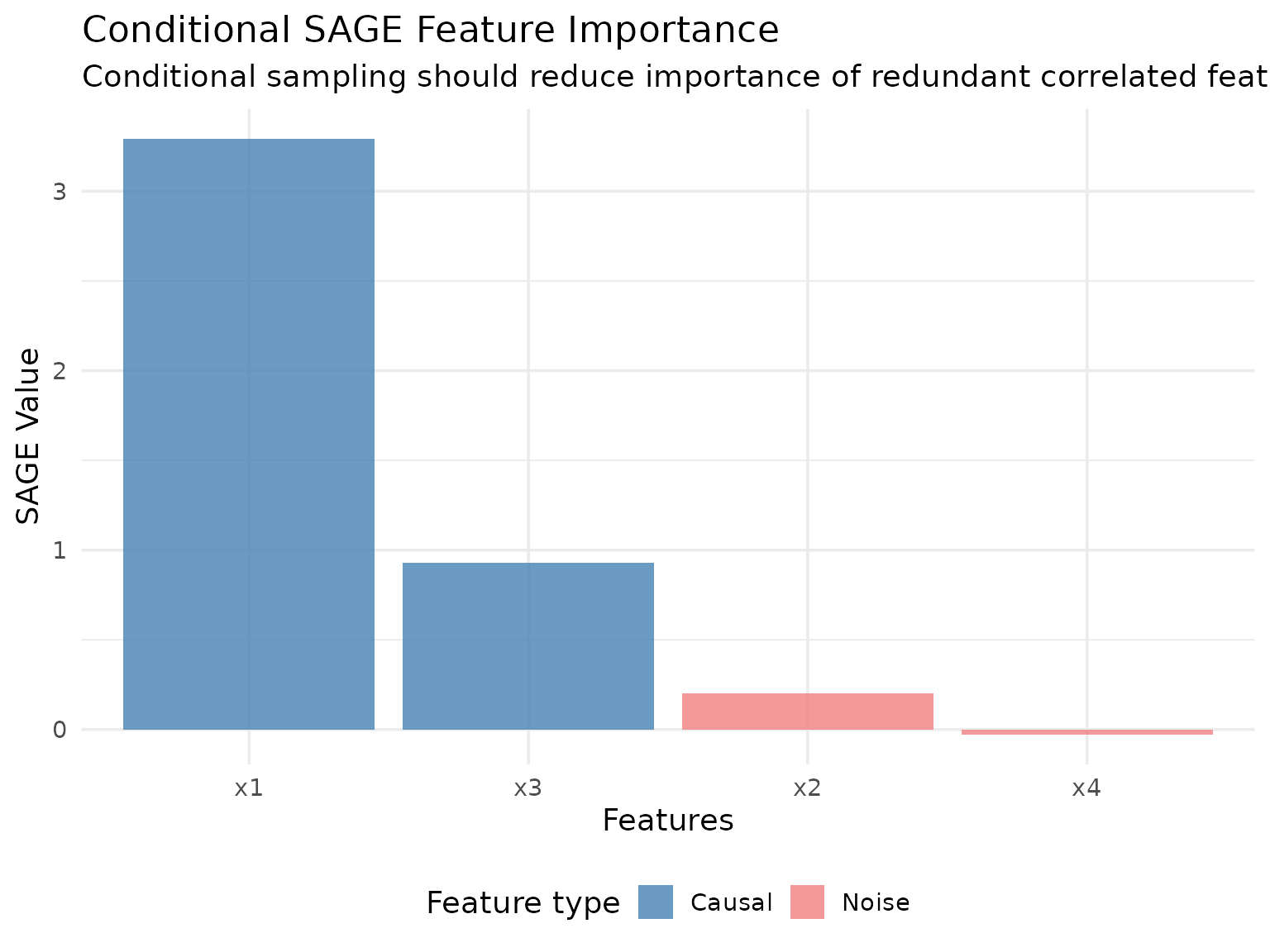
Let’s visualize the conditional SAGE results:
conditional_sage$plot_convergence()
#> Warning: Removed 4 rows containing missing values or values outside the scale range
#> (`geom_ribbon()`).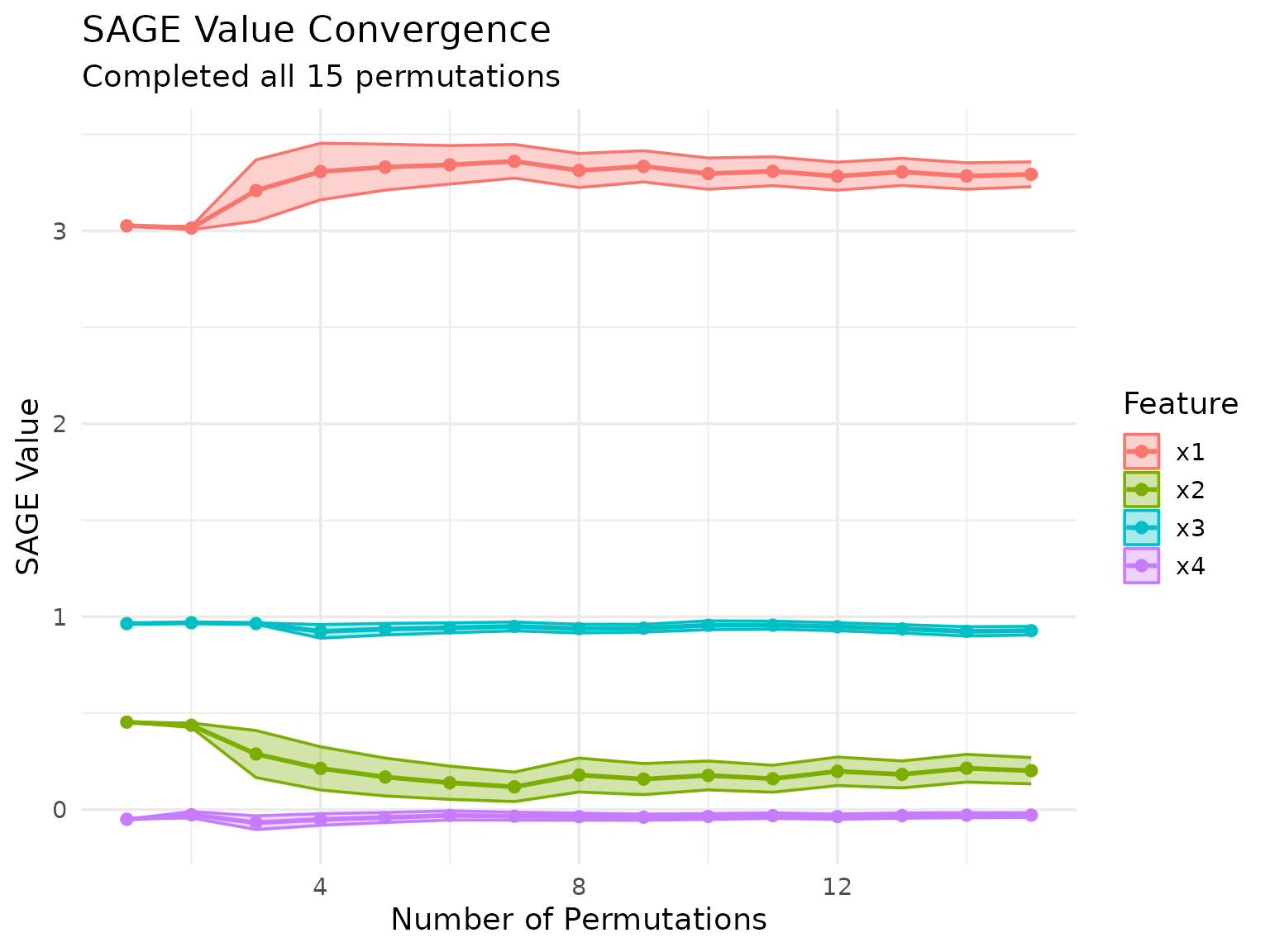
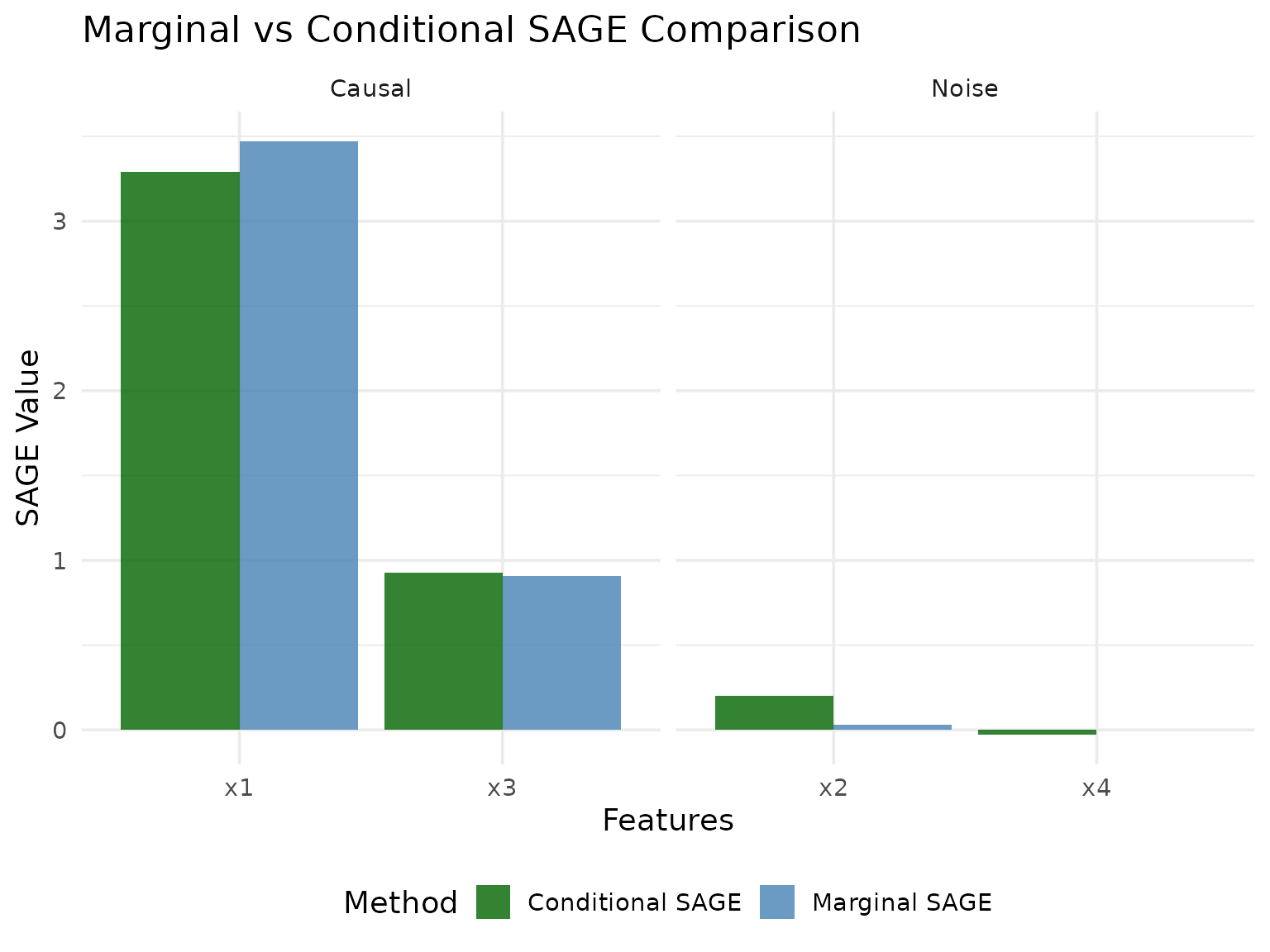
Comparison of Methods
Let’s compare the two SAGE methods side by side:
Methodological Notes
The difference between the two methods:
MarginalSAGE: Marginalizes all out-of-coalition features simultaneously by sampling from the marginal distribution, but does not account for conditional dependencies between in-coalition and out-of-coalition features.
ConditionalSAGE: Uses conditional sampling to “marginalize” out-of-coalition features while preserving the conditional dependency structure between in-coalition and out-of-coalition features.
The interpretation of SAGE values, particularly for ConditionalSAGE, can be affected by the specific conditional sampler used and the nature of feature dependencies in the data. The choice of sampler can significantly affect results, and there is currently limited empirical guidance on best practices for different settings.
Comparison with PFI and CFI
For reference, let’s compare SAGE methods with the analogous PFI and CFI methods on the same data:
# Quick PFI and CFI comparison for context
pfi = PFI$new(task, learner, measure)
#> ℹ No <Resampling> provided, using `resampling = rsmp("holdout", ratio = 2/3)`
#>   (test set size: 333)
cfi = CFI$new(task, learner, measure, sampler = sampler_gaussian)
#> ℹ No <Resampling> provided, using `resampling = rsmp("holdout", ratio = 2/3)`
#>   (test set size: 333)

pfi$compute()
cfi$compute()
pfi_results = pfi$importance()
cfi_results = cfi$importance()

# Create comparison data frame
method_comparison = data.frame(
    feature = rep(c("x1", "x2", "x3", "x4"), 4),
    importance = c(
        pfi_results$importance,
        cfi_results$importance,
        marginal_results$importance,
        conditional_results$importance
    ),
    method = rep(c("PFI", "CFI", "Marginal SAGE", "Conditional SAGE"), each = 4),
    approach = rep(c("Marginal", "Conditional", "Marginal", "Conditional"), each = 4)
)

# Create comparison plot
#| fig.alt: "Grouped bar chart with features on x-axis and importance on y-axis. Four colored bars per feature for PFI, CFI, Marginal SAGE, and Conditional SAGE."
ggplot(method_comparison, aes(x = feature, y = importance, fill = method)) +
    geom_col(position = "dodge", alpha = 0.8) +
    scale_fill_manual(
        values = c(
            "PFI" = "lightblue",
            "CFI" = "blue",
            "Marginal SAGE" = "lightcoral",
            "Conditional SAGE" = "darkred"
        )
    ) +
    labs(
        title = "Comparison: PFI/CFI vs Marginal/Conditional SAGE",
        subtitle = "Comparing perturbation-based and Shapley-based importance methods",
        x = "Features",
        y = "Importance Value",
        fill = "Method"
    ) +
    theme_minimal(base_size = 14) +
    theme(axis.text.x = element_text(angle = 45, hjust = 1))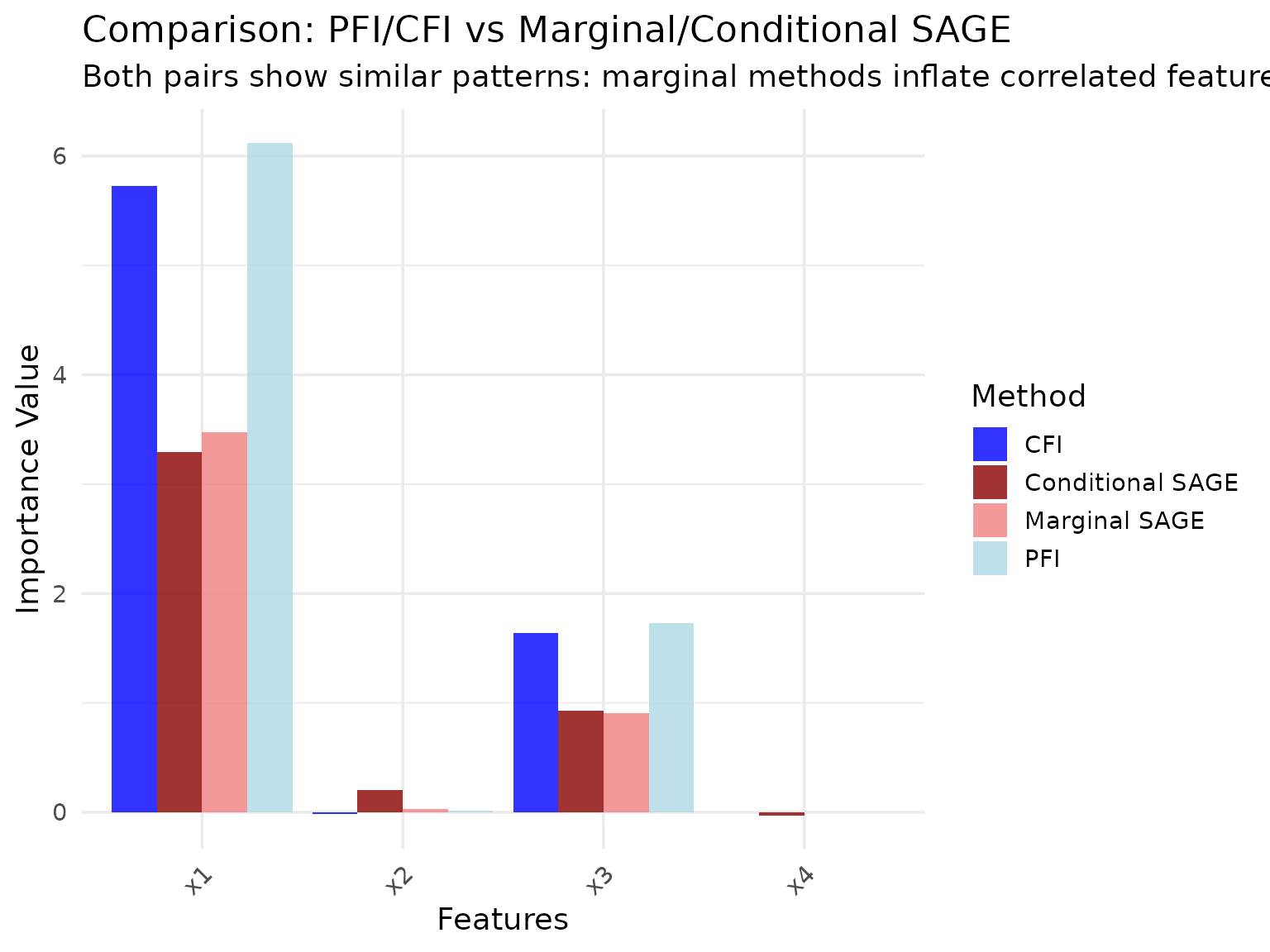
While both PFI/CFI and MarginalSAGE/ConditionalSAGE distinguish between marginal and conditional approaches, these method families measure fundamentally different quantities. PFI and CFI measure the drop in predictive performance when features are perturbed, making their interpretation in terms of prediction loss relatively straightforward. SAGE methods measure each feature’s contribution to overall performance through Shapley value decomposition, which involves a different theoretical framework. The results shown here demonstrate the methods on the same data, but direct comparisons of the numerical values should be made with these methodological differences in mind.